Category Archives: Dad

Your Number

It was the only story Dad told us about the missions he flew when he was stationed on the USS Monterey , an aircraft carrier, during WWII.

Oh boy did we have fun, Dad would say.  We’d go out on a mission, and then head back to the ship.  We flew so low, we could feel the spray of the water from below us.  We’d fly just this high over the waves!  He’d hold his hand out at the exact height of my head.  No matter how tall I got, that’s just how far above the waves Dad, Smokey (their navigator and Dad’s best wartime buddy) and their pilot flew.  Not high above them at all.

The Japs, he’d say (before there was such a thing as PC), they couldn’t do it. They couldn’t maneuver over the waves.  We could, and we lost them that way every time.  They never managed to hit us, and they couldn’t follow us back to the ship.

And we had a blast.  Cheating death, every day.

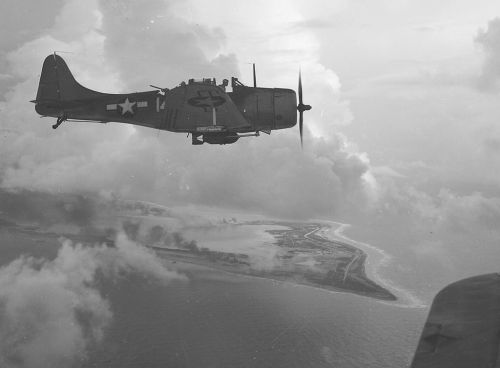
SBD_Dive_Bomber_over_Wake_Island,_1943

An SBD Dauntles, over Wake Island in the Pacific, 1943. My Dad was the gunner; he rode backwards. Photo credit (via Wikipedia) Lt. Charles Kerlee. USNR – General Photographic File of the Department of Navy [1] or [2]

Every time, I asked the same question:

“Dad, weren’t you scared?”

You see, I’m a total coward, I fear pain and injury.  The idea of anybody enjoying a near-death experience, riding 2-5 feet above the waves of the Pacific Ocean, with enemy planes shooting at them, well, it always seemed unbelievable to me.

When you’re number is up, it’s up, Dad would say, shrugging his shoulders, every time.  Nobody gets out alive!

That was Dad’s philosophy, learned in the ready room of the USS Monterey.

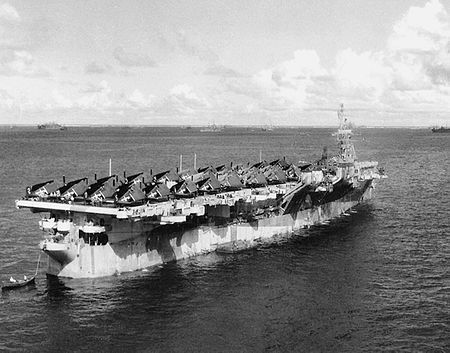
USS_Monterey

The USS Monterey, Dad’s Ship for most of his time in the Pacific.

That was where we hung out when we were off duty — the Ready Room.  That’s also where the duty roster when up — where we’d find out when we were flying out to meet the Japs.  Each squadron had a number.  When you’re number was up on the board, you went out.  And when your number was up, you never knew if you would make it back to the ship. 

We understood that “when your number was up” meant a bit more than a flight for many of Dad’s fellow service men.

I’m not sure if Dad’s philosophy became my own through osmosis or because I thought about it and realized he was right.  Maybe a little bit of both.  But I more or less agree with Dad.  When your number is up, it’s up.  And worrying about it, well, to quote Dad, won’t make a lick of difference.

I think of this as a gift from my Dad.  One that has lasted long past Dad’s own expiration date.

There is no point in worrying about dying. It’s gonna happen to all of us.

What’s important is how we live.

We need to remember who we are, recall the immigrant roots of our country, and how it was immigrants — my ancestors and likely yours — who made America what it is.

We need to remember that to our shame, we closed our borders to Jewish refugees in the 1930s and 1940s.  Remember what happened to them?

We need to thumb our collective noses at the terrorists, and just not give in to the terror.

This cartoon, on the cover of Charlie Hebdo, the recipient of France’s previous horrible terror attack thumbs its nose at the terrorists.

Charlie Hebdo cover

Enter a caption

Charlie Hebdo cover: They have weapons. Fuck them. We have champagne.

Source:  Huffington Post.

Let’s all get our thumbs into position. Oh and get our hearts into the “open” position.  Because that is who we are as people.

Statue of Liberty - Flickr

Flicker Image

“Give me your tired, your poor,
Your huddled masses yearning to breathe free,
The wretched refuse of your teeming shore.
Send these, the homeless, tempest-tossed, to me:
I lift my lamp beside the golden door.”

61 Comments

Filed under 'Merica, 2016, Adult Traumas, All The News You Need, Cancer on Society, Crazy family members, Dad, Do GOP Voters Actually THINK?, Elections, Elections Matter, Family, History, Huh?, Love, Memoir writing, Missing Folks, Taking Care of Each Other, WTF?

An Ordinary Tuesday

There was no reason to panic, just because Dad had disappeared shortly before he was supposed to “walk me down the aisle.”

“Find Beth,” I said to Mom, who was there in the church’s multifunction room that was functioning as the bride’s dressing room.

Beth had been my problem solver for nearly three decades by the time I was getting married. And she’d never let me down.  Beth could calm the crazies in me better than anybody I’ve ever known.  Just knowing she was around, made everything OK.

And if you had a splinter or a cut or any injury at all?  Go to Beth.  That was true long before she became a nurse who treated premature babies.  If ever there was someone with nursing in their DNA, it was Beth.

https://www.youtube.com/watch?v=YpAq8FBwWY4

Surely Beth could find Dad, who’d gone for a walk, and get the keys to the car from him.  Because, while I’d gotten my wedding dress out of the car, everything else I expected to wear, beginning with my underwear, was locked in the trunk.  And the keys were in absent Dad’s pocket.

Fast forward to 2009.  July 4th was just days away, John, Jacob and I were in Maine, and I was in a panic.  My eldest brother, Bob, had just been taken to the hospital.

For a decade approaching holidays had terrified me.  I suffered from “heortophobia”the fear of holidays.   Well, my heortophobia had a twist:  It wasn’t simply a fear of holidays.  Nope.  For me, it was a perfectly logical terror of illness at holidays.  Someone else’s illness.  Because If anybody I cared about had so much as a sniffle, well, they were gonna die.

As you may have heard 4,327 times, my family members have a nasty habit of dying on holidays.  They’ve hit the all big ones — In order of occurrence:  Thanksgiving.  Easter.  My birthday.  Christmas.  Ho ho ho!

So when Bob ended up in the hospital with Independence Day approaching, well, I knew Bob was toast.  The odds, and likely the Gods, were against him.

“He’s not that sick, Lease.”  Beth said.   “You’ve been sicker and survived.”  She’d contacted his doctors, figured out what was wrong, and called to reassure me.  Beth, a nurse, knew this sort of thing. But as a fake medical expert with then six years’ experience, I was learning more and more –enough to make me fear everything, actually .  So naturally, I wasn’t so sure.

“Beth,” I said, through slightly clenched teeth. “It doesn’t matter how serious his illness is.  It’s the dateA HOLIDAY IS COMING.  He’s going to die!”

As the eldest in the family, Beth had been able to calm me down my whole life long.  She didn’t fail this time, either.

“Nobody is going to be able to trump Dad dying on Christmas,” she said, matter-of-factly.  “The Holiday Death Sweepstakes is over, Lease.  Fourth of July?  Pffttt.  Independence Day isn’t even a contender!”

“I HATE holidays,” I moaned, panic starting up again.

“Lease, I’m gonna make you two promises.”  Beth had always kept her promises. “First, Bob will be fine.”

“Mmmm,” I replied, not believing it for a minute.  Still, I started to calm down.

“Second:  When I go, it’ll be on an ordinary Tuesday,” Beth laughed.  “I cross my heart and hope to die, Lease, I will not die on a holiday.  I mean it.  I couldn’t do that to you,” she laughed still harder. At me, not with me.  Had she been nearby, I might have smacked her for ridiculing me.  Hard.

Bob, whose illness wasn’t all that serious, was released before the holiday; his sentence commuted.  I breathed a sigh of relief, let me tell you.

Google Image, Natch

Google Image, Natch

But not for long.

On a Sunday, just over a month later, I called Beth.  We talked nearly every day.  Beth had had a pretty severe stroke two years previously. It affected her kidneys; she had been on dialysis for about two years.  Things hadn’t been going well, and she was more and more discouraged, depressed and disheartened.  More importantly, he hadn’t been feeling well in the last couple of days.

Still, I was surprised when her phone was answered by one of her sons.

“Mom’s in the hospital,” Chris told me.

It was a Sunday, though.  In August.  No holidays in sight.  So while I worried, there was no need to panic right?  Chris promised that he and his brother would keep me informed.

Late Monday morning, Dave, Beth’s eldest son, called me in tears.

“They don’t know if Mom’s gonna make it.”

I rushed home, packed a few things, and got into the car, and headed to Cleveland.

The weather was horrible.  Storms raged — the rain so heavy that I could barely see.  Traffic rushed by or crept along.  Trucks on the Pennsylvania Turnpike flew by at terrifying speeds when traffic moved.  But mostly, the highway was at a standstill, the rain not letting up.  I couldn’t get to Beth, and I couldn’t see to drive.

How much of my impaired visibility was due to my constant tears, and how much to the pouring rain, well, I didn’t know.

Dave called me again in the early evening to let me know that Beth was in a coma; they thought she would make it for another day or so.

So, exhausted I pulled onto an exit just above Pittsburgh, and into the first motel I found, where I collapsed into bed.

Beth’s doctor called me a few hours later.  Beth had taken a turn for the worse.  If I wanted to see her, to be with her, I’d better get back on the road.

I made it in time for Beth to personally deliver that second promise.  She died on an ordinary Tuesday, August 11, six years ago.

With her passing, Beth brought me an unexpected cure of my heortophobia, and even let me laugh at the bizarre trend she ended.

And on the way back?  The weather was clear.  The Pennsylvania Turnpike twists and turns through the mountains.  With each curve I rounded as I drove home, there was a rainbow.  Rainbow after rainbow.  I knew, seeing those colors in the sky, behind every turn, that Beth was comforting me still.

I miss you, Beth.  Oh, and I was the one who spilled nail polish remover on your new dresser in 1967.  Sorry about that.

87 Comments

Filed under Adult Traumas, Anniversary, Church, Crazy family members, Dad, Family, Heortophobia, History, Holidays, Huh?, Humor, Love, Maine, Missing Folks, Oh shit, Shit happens, Sisters

Fathers and Daughters

The father-daughter relationship is fraught with all the possibilities a therapist could wish for.  Even in my family.

Well, except for my relationship with my father.

You go ask Dad …” was one of the enduring sounds of my childhood.I only asked “why me” once:

It was a hot summer day when I was about four.  I was happily cooling off in the puddles on the sidewalk.  I didn’t even really want to go to the beach.  My brothers and sister did, though.

“Go ask Dad if he’ll take us to the beach,” Judy commanded.

That summer, Dad, already working two jobs to support his wife and five kids was studying to take his insurance licensing test.

“Why me?” I whined.  “I always have to ask Dad.”

“‘Cause when you ask him, he always says yes” Bob responded.  Judy and Fred agreed.

So I went in and asked him.

Sure enough, he packed up his books, loaded the four of us up into the car, and headed off to Beardsley Park, where there was a delightful stream that formed the most wonderful pools of different depths, where we would each be happy and cool.   I can still see Dad sitting on a rock ledge in the shade, his pants legs rolled up, his feet in the water and a large black binder on his lap.

I never again asked “Why me” when it came to getting Dad to do anything. Because I realized that my brothers and sisters were right.  Dad always said yes to me.

Somehow, the fact that I was the clear favorite in Dad’s eyes was rarely held against me by my brothers and sisters who all had far more complicated relationships with Dad.  It was pretty much accepted by everybody.  That’s just how it was.

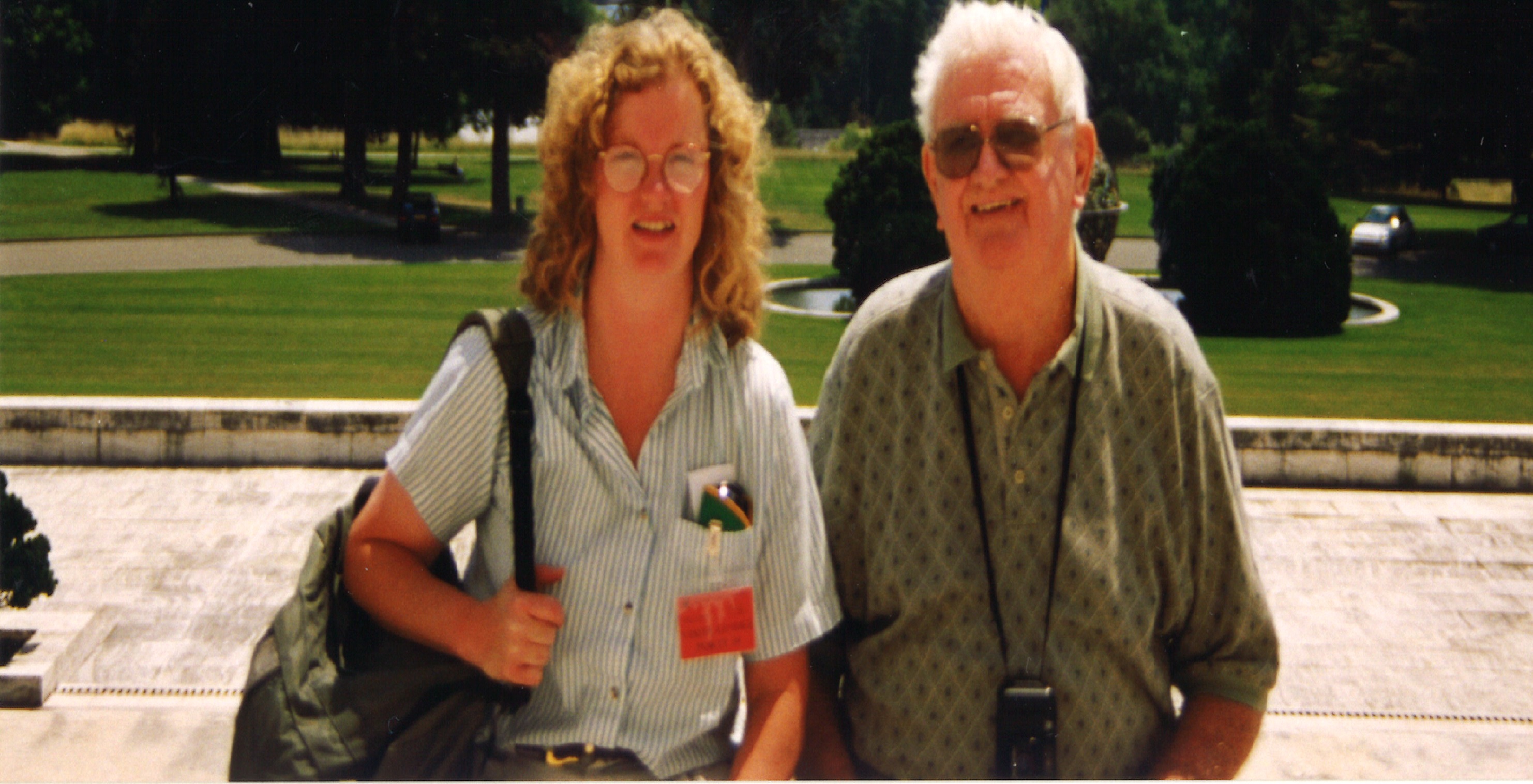
Dad and Me in Geneva, June 1998.  You have to guess which is me.

Dad and Me in Geneva, June 1998. You have to guess which is me.

I don’t have any recordings of his voice, which was deep and scary (to everybody but me) when we were kids, and became deep and comforting when we were grown. But this song, while he never heard it, always makes me feel close to Dad, who died in 2000. Today would have been his 98th birthday.

I love you, Dad.

55 Comments

Filed under Baby You Can Drive My Car, Birthday, Crazy family members, Dad, Family, Father-Daughter Relationships, Geneva Stories, Holidays, Humor, Love, Missing Folks, Taking Care of Each Other, Why the hell do I tell you these stories?, Writing

Why I Don’t Pray

As soon as John and Jacob saw me, they knew something was up. Something weird. Because I hadn’t looked nearly so cheerful the last time they’d seen me.

I had to admit, they were right.

Even though on that particular day, I had planned to be thoughtful. Sad. Mournful. I planned to wallow just a tad. It was, after all, the first anniversary of my mother’s death. I was a long way away from my heartbroken Dad; I wouldn’t be able to call and let him know that I was thinking of her. I felt, well, I felt I deserved it, because sometimes, no matter where you were, you just have to give into the loss.

That had been my plan, anyway. That’s not exactly what happened.

Did you see the movie The Monuments Men? It was pretty much panned by the critics, but I really liked it. It was about a group of academics who went to war to save great art from Hitler. It had compelling action, great works of art, and the struggle against good and evil. Equally important, it had no robots in it. Or baseball.

https://www.youtube.com/watch?v=CreneTs7sGs

Naturally, since that trailer rudely left out the most important part of the movie – the one that I was involved in, I’m going to actually have to write this story up.

Anyway, the movie stars George Clooney, Cate Blanchett, Bill Murray, Matt Damon and the Earl of Grantham and an alcoholic has-been looking for redemption.

Oh, and Lord Grantham is also looking for the particular sculpture commemorated in this post. That’s actually where my story comes in.  Well sort of.

Anyway, John, Jacob and I were In Bruges (another really great movie, actually). Bruges is a lovely old city, that seems like it is stopped in time, which is kind of because it WAS actually stopped in time.

A busy, beautiful port city that, according to Wikipedia, was:

At one time, it was considered the “chief commercial city” of the world.[6] “Rise, fall and resurrection make up the life story of Bruges, a city that glittered in Northern Europe with as much panache as Venice did in the Mediterranean World.”[7]

Only the harbor silted up, and its use as a port was history. Today?  Today, it’s a damn pretty place.

We’d been traveling for a few days, had had our own Waterloo; we’d been to Amsterdam, where we visited Ann Frank’s attic, where Jacob drove a boat filled with tourists through crowded canals, and where John and I accidentally introduced our 8 year old to the Red Light District. So we were ready to just relax and wander when we got to Bruges.

The centerpiece of the town is the Church of Our Lady, Bruges, a beautiful cathedral built between the 13th and 15th Century. It is found in the heart of the town square.

Wikipedia Image (you thought I was gonna say

Wikipedia Image (you thought I was gonna say “Google,” admit it.)

It’s a lovely church, but its altarpiece alone makes it worth the trip.  It is world famous, a luminous, transcendent sculpture that one feels as well as sees.  It has an illustrious history of its own, Michelangelo’s Madonna and Child. The sculpture was the only one of his sculptures to leave Italy during the artist’s lifetime.  More currently, and relevant to the movie theme in this post, it was one of the pieces of art most sought after by the Third Reich. The Monument Men were tasked with preventing the Nazis from getting it (or destroying it) as they retreated at the end of the war.

Wikipedia Image, again.

Wikipedia Image, again.

I’m not going to tell you what happens, but I will say, that the Monument Men didn’t have an easy job of it.  Of course, I could have told them that they were wasting their effort. Because as I found out, Michelangelo’s Madonna and Child was well guarded. Even when nobody was really after it.

Are you still with me?  OK, let’s get back to me.

Well, I started the visit to the Church with John and Jacob, where we taught our young son the history of the church, looked and discussed the art work throughout the church. We went to the gift shop, where I bought a flier about the Cathedral for my Dad, and a remembrance for Jacob. We’re good parents.  We knew the routine. After a while, John and Jacob left to climb the tower overlooking the other side of the square. They left me to meditate, to think about my mother, to grieve. It was very considerate of them. Sadly, my reflection was short-lived.

The Church was nearly empty, and the late morning light shone through the stained glass, coloring the floor in front of the Madonna. I could hear the breathing of the few people looking at the paintings, there was an elderly couple doing the Stations of the Cross. But mostly I was alone with my Mom. And with another mother and baby, right there on the altar in front of me.

There are some pieces of art that reach out and touch you. That fill your heart. That start your healing as you gaze. Michelangelo’s Madonna and Child is one of those.

In the back of the church, coming from near the gift shop, I heard an announcement, softly broadcast over the intercom system. A few minutes later, I heard it again. It was in Dutch. Or Flemmish. Or Bruge-ian. I didn’t understand it. Ok, so I ignored it. What could be so important?

I continued my contemplation. I began to think of my Mom, to weep quietly, tastefully. Hardly at all noticeably, when somebody roughly grabbed my arm and shook it.

“#*&%+##@@*!” said a very tall, very grave Nun. I was pretty sure she had a ruler in her pocket. All the stories my siblings had told me about the nuns they had known – all of whom believed firmly in beating children, flooded into my mind.

“Excusez-moi, Madam?” I stammered.

“#*&%+##@@*!  #*&%+##@@*!” she repeated, which she should have known wouldn’t help, since I didn’t have a clue the first time around.

“Excuse me, M’am. I don’t understand you,” I said to her in English.

“EEENglesh!” she said, as if that explained everything. “YOU MUST LEAF.  NOW!!!

“LEAF?” I responded, confused. Why did I have to LEAF? I was in a church. In mourning. I WAS PRAYING FOR CHRIST’S SAKE! “I am here for my mother, she died,” I said, and I started to cry.

“OUT!” she shouted, pulling me.

Google this time.  You got me.

Google this time. You got me.

This was NOT Sister Bertrille.

She grabbed me by my sleeve, pulled me from the pew, walked me to the door, and firmly shoved me outside.

Now, I have been caught doing many untoward things.  But this time?  This time I was thrown out of a church. WHILE I WAS PRAYING.  Isn’t there some eclesiastical law against that?  Call the Pope.

*     *     *

So, when I saw The Monuments Men, well, I wish I’d been around during that day. They didn’t have to work so very hard, give up so much to protect Michelangelo’s Madonna and Child. All they needed was one nun in need of a sandwich.

*     *     *

This post was brought to you courtesy of Frank at AFrankAngle.  He suggested I write it up the story of how I was thrown out of a church, so I did.  Note to self:  Remember to thank folks who inspire and who also actually read your blog.

59 Comments

Filed under All The News You Need, Anniversary, Awards, Bruges, Church, Dad, Europe, Missing Folks, Mom, Nuns, praying, TAGS THAT DON'T Work, Thrown out of Church, Travel Stories

The End of My Rope — Again

Just like three years ago, I am anxiously awaiting the Supreme Court’s decision on the Affordable Care Act.  Three years ago, I was fairly certain that the right-leaning Court would deem Obamacare unconstitutional.  Three years ago, I was lucky.  And I wrote about it here.

Today, tonight, as I wait for the decision on a far more pedestrian case, I’m still worried.  OK, I’m worried again.

You see, the “Prime Directive” of my life, from the age of 17, has been having and maintaining health insurance.

That’s what happens to you when you develop health problems, regardless of the age.  You need to put your square peg of a life into a round hole of getting the treatment that you need.  It never fits.  And you always lose a lot of yourself.  Oh, and all of your dreams.

And frankly, I resent it.

Healthy folks don’t understand just how thoroughly something most people take for granted — good health, good health insurance — can literally mean the difference between life and death.

Because I’m sure — positive — that the Supremes will be reading this blog, and for the new-ish friends who haven’t read this piece, I’m re-posting my most intimate post.

The End of My Rope

Friday, the first of October, 1982, was a really bad day.

Actually, it was a mostly normal day even after I found a memo and a pamphlet in my office in-box. The law firm where I’d worked for more than three years had just changed health insurance companies. The information about our new policy, beginning November 1, 1982, three weeks before my scheduled surgery, would be with Liberty Mutual. I didn’t give it a thought.

But Andrea, one of my bosses, suggested I give them a call. “You’d better make sure they know about your operation and don’t need more information.”

So I called the number on the brochure.

Forty-five minutes later, Andrea found me at my desk, staring blankly at the ‘Sitting Duck’ poster hanging on my wall. It showed a white cartoon duck wearing sunglasses.  He’d been enjoying himself, sitting in the sun in a turquoise blue lawn chair on the side of his house, sipping a soda.  But he was looking in wide-eyed surprise over his right shoulder at two bullet holes in the wall.

Sitting duck poster

Poster by Michael Bedard
http://www.mbedard.com

I knew that if I looked over my shoulder, I’d see some bullet holes as well. I was that sitting duck — I always seemed to be dodging bullets.  Life with chronic illness had become one fucking thing after another.  Now, just when I’d accepted and agreed to the surgery that so terrified me, my insurance was gone.  BANG! BANG!

“What’s wrong?” Andrea asked.

“It’s not covered,” I said, numbly, without a hint of emotion. Then I began to hyperventilate. “’Pre-… pre-… pre-existing condition,’ they said.”

“What?”

I explained what I’d been told, that the new policy didn’t cover anybody for 30 days and that it didn’t cover pre-existing conditions for a year. The firm had changed insurance to save money. Their decision would cost me everything. Everything.

I didn’t want to have the surgery — it terrified me. But I’d adjusted, accepted that I was, in spite of my attempted denial, quite sick, and that I had to have the operation. But I couldn’t possibly pay for it. Where was I going to get the tens, maybe hundreds of thousands of dollars I’d need? I lived pay-check to pay-check, and rarely had a nickle to spare; I had no savings. My parents were retired, living close to the bones themselves. My siblings were likewise broke. And I had insurance!

Loss of the insurance meant one of two things.  I could have the surgery that I really didn’t want to have anyway and pay for it myself. Or I’d face another year of ever-worsening illness — hemorrhages, bleeding, weakness, diarrhea.  Dr. C had been clear — my colitis was not just going to go away, as much as I wanted it to.

Without insurance, even if I could convince my surgeon, the hospital and the zillions of other folks involved in a major operation to actually do the surgery on someone without insurance, I knew that I would spend the rest of my life trying to pay the bills.  Bills that would have been covered just the day before.

My mind whipsawed between the injustice of the loss and terror at what would happen to me if I didn’t have that damn operation.

Andrea came around to my side of my desk and put her hand on my arm. “We’ll figure this out, Elyse. It’s late now, everybody’s gone. But we’ll work this out on Monday.”

She sounded reassuring; I was unconvinced.

“Really, it’ll be OK,” she repeated. “But in the meantime, I need you to …”

Her voice trails off in my memory. Andrea was a compulsive workaholic, an A-type personality. Work always came before anything else. Other people at the firm thought it was annoying, insensitive, or worse. But for me, it helped. It was exactly what I needed. It took my mind off me. I did what she asked, finished up and went home.

Of course I fell apart once I was home and told my roommate, Keily, the news. I ranted, raged, and cried — I wallowed all evening.

“I don’t even want to have this operation,” I shouted as loudly as I could to Keily as I sat in the bathroom, the door open. My gut, naturally, was erupting. It almost always was by then, especially when I was upset. Cramps. Diarrhea. Blood. Urgency. My shitty symptoms mocked me, proving that I couldn’t avoid the surgery. That I couldn’t put it off until my insurance kicked in. That I was totally screwed.

Keily sat outside the bathroom at the top of the stairs, stroking Goliath; that was her perch as I got sicker and sicker. She sat there and talked to me. She kept Goliath out of the tiny bathroom (Keily’s only successful effort at getting the Goose, as we nicknamed him, to obey.) That night, she held Goliath, and soothed him and me at the same time. She let me vent, rage, rant.

“It’ll work out. There’s some mistake. They can’t just do this to you. You need to trust the folks at your office.” Keily said repeatedly.

“You mean the ones who agreed to the new policy?” I wasn’t in a mood to listen.

That night I’d skipped Goliath’s after-work walk. It was getting on towards 10 p.m. and he needed to go out. I needed to do something else, or at least cry somewhere else. Walking clears my head, lets me figure out how to fix a problem, helps me find an answer. I knew a walk would help.

“Do you want me to come?” asked Keily. She often did, and that night she was concerned. I was so shaky and upset.

“No, thanks, I think I need to be by myself,” I responded. “I’ll be OK.” Actually, I was wishing I could leave myself behind. I was sick of me. Sick of sick me, anyhow.

So Goliath and I got into the VW and headed to the Capitol grounds, where we walked most nights. It’s such a beautiful, inspiring place. Plus for a woman walking her dog, it’s perfect. Of course it’s well lit — you can see it for miles. But there are also security patrols that never bothered us but nevertheless made me feel safe. A 120 lb. German Shepherd helped make me feel secure, too.

It was a clear night, with a half-moon casting shadows from the beautiful cherry and oak trees, from the enormous rhododendron bushes and other carefully tended shrubs across the expansive West Lawn. Nobody else was in sight.

I let Goliath off his leash. Deep in my own thoughts, I didn’t pay much attention to him. Unusually, he stayed right with me that night. He was as worried as Keily.

I cannot believe this is happening to me, I thought, rage building again at the injustice. Because my whole entire adult life had been focused on making sure I had health insurance.

From the time of my first hospitalization at 17, I had lived my life — made every single decision — with health insurance in mind. My dreams of acting, of singing, of writing? Of doing whatever the hell I pleased? They’d all been flushed down the thousands of toilets I’d had to rush to over the 10 years since my diagnosis.

After my first hospitalization, and with word from the doctor that my ulcerative colitis would likely flare up repeatedly throughout my life, my parents forced me to go to secretarial school – a career path that had never figured into my plans. My mother was an office worker and she’d always hated her job.  It seemed boring and demeaning. Secretarial work had once been a good career path for bright women. But that, I thought in my young “know-it-all” way, was no longer the case. Mom was stuck with it, and she and Dad stuck me with it, too.

I complained bitterly; I was talented, funny, smart. It wasn’t fair.

I was wrong about both the work and the women who worked as secretaries. I quickly became pretty ashamed of my attitude, and some of the secretaries I knew became great friends.

Still when the chance emerged to turn a secretarial job into a job as a legal assistant, I jumped at it. In the job I’d had now for three years, I wrote for a living, analyzed legislation and regulations for the firm’s clients and learned about U.S. politics and policy. It was a terrific job. The firm had been good to me. And my parents were happy because I was still working in an office. With health insurance.

Another wave of anger came as I walked down the groomed hillside.

And then I saw it. Something I’d never seen there in the dozens of times I’d walked that route. Inexplicably, on the West Lawn of the U.S. Capitol Building, there was a pole sticking out of the grass with a chain attached at the top, and a ball hanging down.

Tetherball.

I walked up to it and started smacking that ball. I’d only seen cheap sets with rope attaching the ball to the pole. This one had a strong chain that was covered in a canvas sheath. But instead of improving my mood, hitting the ball deepened my feelings of desperation.

SMACK. I hit the ball as hard as I could. “MY BODY HATES ME!” I shouted as I pushed the ball around the pole.

WHACK. “MY LIFE SUCKS!”

SLAM. “Fucking, fucking FUCKING INSURANCE!

SMACK, SMACK, SMACK. “Hopeless. Hopeless. Hopeless.”

With each hit of the ball, I pushed myself towards the end of my own rope. There was no way to unravel all the problems I was facing, the problems that kept expanding.  Just as I thought I’d licked one, it would multiply. No way to fix all the crap that kept piling up. Crap that I suddenly felt that I was facing alone.

That was the moment when I realized, with surprising clarity, that life just wasn’t worth the trouble. At least mine wasn’t.

I decided at that moment to hang myself. I would hang myself from the tetherball chain on the grounds of the U.S. Capitol.  It suddenly became the perfect solution.

I saw no way out. I couldn’t continue, didn’t want to continue. And I’d gotten way past the amount of shit I could deal with.

I sat down on the grass on the hill just above the contraption and allowed myself one last cry. Naturally I didn’t have any Kleenex. Snot running with my tears did not make me feel any better.

The first problem I discovered was that I couldn’t quite figure out what to call the thing. It seemed important that I know what to call it if I was going to die on it.

I wondered: Is it a tetherball set? A tetherball apparatus? A tetherball thing-y? I didn’t know the answer.

Goliath tried to distract me, to cheer me and when that didn’t work, he sat down next to me and let me use his shoulder. He tried to lick my tears away, but they kept coming. He butted his head into me. But he got bored with my misery and wandered away.

I didn’t watch where he went, I didn’t care. It didn’t matter where he went, what he did. Whom he harassed. I was done.

The decision was made.

I got up and walked up to the tetherball thing-y and realized what I hadn’t noticed before: that the chain was actually quite short. Too short, possibly, for my plan. The ball itself fell to just the height of my shoulder.

I was shocked. How am I going to do this?

I reached up, stood on my tippy-toes like a kindergartner, grabbed the chain in my left hand, and tried to pull it down a little more. But it was a chain, so it was very strong and not at all stretchy. It was also pretty thick, about 2-1/2 inches wide and not terribly pliable.

I stood there, grunting, sobbing, trying to stretch my body. I held the ball and the bottom of the tether chain in my hand, trying to figure out a way to make this work. Wondering if I could quickly have a growth spurt.

How can I get this short thick thing around my neck?

Even on my tippy-toes and pulling it as hard as I could, it wasn’t long enough. It just reached from my chin to my shoulder — not even half way around my neck!

What sort of an idiot designed this damn thing with an impossibly short chain? I wondered. You can’t even smack the ball around the pole more than a couple of times.

Not to mention that it wasn’t at all helpful for putting me out of my misery.

I pursed my lips and moved them from side to side like Charlie Chaplin’s little tramp. I rubbed my chin and scratched my head.  Tried to solve the shortcomings.

Naturally, other problems popped up too.

What can I jump off of?

Of course, the answer was “nothing.” I was on the manicured grounds of the Capitol. I couldn’t pile up debris and jump off of it because there was no debris. The neat grounds rarely had much in the way of move-able objects.  I was starting to get annoyed.

I want to die. Now. Tonight. On the tetherball thing-y. How the hell can I do this?

There on the West Lawn of the United States Capitol Building — with security patrols passing every 10 or so minutes — I was hell-bent on committing suicide by tetherball.  I was trying to stretch, to grow, to find a ladder, a chair, anything I could jump off of with a piece of US Government-issued sports equipment wrapped around my neck. Wanting to and trying to die.

And then it hit me.

Or rather, he hit me. Goliath, of course.

SLAM! Something hard hit the back of my legs.

“Owwww!”

From somewhere on the grounds, Goliath had picked up a huge stick – an uprooted tree by the size of it. It was at least five feet long and four inches around. His mouth was stretched to the limit holding it. And he’d hit me with it in the back of my legs.

WHACK! He did it again. I turned and saw that he’d lowered his chest towards the ground into a bow. He kept his rear end high in the air, wagging the whole back half of his body ferociously.

He’d had enough of me feeling sorry for myself. It was time to play. So he rammed me with it again.

“Owwwww, Goliath STOP THAT!” I commanded.

He didn’t listen. He went around to my left and hit me with it again. His eyes caught the moonlight – they sparkled. He was laughing at me.

SLAP! “Owwww, NO! That hurts. Cut it out!”

He bounced to my right side with the long thick branch firmly in his mouth. Pretending to loosen his grip on it. Teasing me. Trying to get me to play. Wanting me to reach for the stick, which he would never give me.

(Come on, Mom, catch me!) He was play growling at the stick and at me. He bowed again, swung his head to and fro, and the long stick swung left to right, wobbled up and down. It got stuck in the ground for a second, and then he forced it back out again with a flick of his massive head. Goliath came close to me and then bounded off with his treasure. Circling me. Approaching me, but backing off before I could get to him. He never got close enough for me to grab that damn stick.

(Come on, Mom, try to grab it!) We were going to play, whether I wanted to or not. And he hit me with the damn thing again.

“Give me that stick!” I ordered. He wouldn’t. He danced around me and the tetherball thing-y and bashed me and the pole repeatedly.

I’m not sure if he knocked me over or I sat down in defeat, crying. He bashed it into me a few more times, but then lost interest. Goliath dropped his weapon — well out of my reach — and sat down beside me. He put his paw on my lap, his head on my shoulder and nuzzled me. Chewed at my hair and my ear. Let me scratch his ears.

“You silly Goose.” I said pulling his ears and tail affectionately. Hugging him. “You’re gonna kill me one of these days.”

I knew then that I couldn’t kill myself, that night or any other. Nobody in their right mind would take my stupid dog.

 *     *     *

I learned when I went back to work on the following Monday that the person I spoke with at the insurance company was wrong.  Mistaken.  My company’s coverage was considered continuing coverage and so my condition was insured.  I had my surgery and became healthy for the first time in about a decade.

Since the enrollment period for the Affordable Care Act, Obamacare, started, I have been haunted by the memory of the night I nearly ended my own life in a fit of desperation.  And while I think we can all agree that it was the silliest suicide plan ever constructed, that misses the entire point.

And that point is that folks who lose their insurance or who are without insurance are often desperate.  And close to the end of their rope.  I certainly was .

How many other Americans have been in that position?  Hundreds?  Thousands?  Millions?  How many think, consider, and/or attempt suicide?

The New England Journal of Medicine reported the following:

First, many suicidal acts — one third to four fifths of all suicide attempts, according to studies — are impulsive. Among people who made near-lethal suicide attempts, for example, 24% took less than 5 minutes between the decision to kill themselves and the actual attempt, and 70% took less than 1 hour.  (Miller and Hemenway, 2008)  (Emphasis added.)

I am not a traditional candidate for suicide, I don’t have the risk factors.  But I was, literally, at the end of my rope because of a combination of constantly dealing with a difficult disease, being broke because I was young and just starting out, and suddenly losing my insurance.  I would have had a huge financial burden I would never be able to pay off.  All through the bad luck of bad health.  Simple bad luck.

When I hear the anti-Affordable Care Act folks preaching about how we need to get rid of Obamacare, I want to scream.  Because a flawed system is better than the old system, where pre-existing conditions — the very thing that makes insurance absolutely necessary — will be the very thing that made insurance coverage impossible.

We need this program or we need a better program.  Going back to the old system is already unthinkable.

Is Obamacare perfect?  Nope.  Is there a perfect solution?  Nope.  But it is an improvement.  A huge, huge improvement.  And the problems will be fixed.

Health insurance for many people makes the difference between life and death.  Literally and figuratively.

48 Comments

Filed under Adult Traumas, Bat-shit crazy, Criminal Activity, Crohn's Disease, Dad, Dogs, Family, Farts, Flatulence, Goliath Stories, Health, Health and Medicine, History, Huh?, Humor, Hypocrisy, Illness, Law, Love, Mental Health, Mom, Plagarizing myself, Politics, Stupidity, Suicide, Suicide Attempts, Surgery, Taking Care of Each Other, Tetherball, Washington, Wild Beasts, WTF?