Sunday nights used to be family time. Everybody would gather around the TV.
There’s no problem with the picture … it’s a Google Image!
Ed Sullivan
The Wonderful World of Disney
The Smothers Brothers
Glen Campbell
Glen pretty much introduced me to country music. Not the hard core drinking-man/woman-losing-dog-died kind. He gave me some of the most beautiful melodies: “Gentle On My Mind” and “By the Time I Get To Phoenix.” Songs that I still love.
Back then, I didn’t think much about the future. Or about growing old. My parents were old back then in the 1960s and early 70s — I knew they’d been born that way. But the performers on TV would never get old. I knew that then. The Smothers Brothers old? Glen Campbell? Pishawwwww!
Time caught up with all of us. My parents, of course, weren’t really old back then. But they grew into that role, they passed on. One by one the staples of not just my family but our world have faded.
Glen Campbell is fading. As I write this, he is in the final stages of Alzheimer’s Disease; a heartless disease that takes one’s mind long before it takes the body.
The song makes my heart sing, even while it breaks it. Kind of like life.
You may not miss me, Glen, but I’ll miss you. We all will.
It’s Open Season for choosing health care options at my company, and probably at yours.
Personally, I think that they call it something else, because I’m pretty sure that most people associate “open season” with hunting. And people who get as frustrated as I have trying to have relatively simple questions answered should not be invited to think of firearms.
It’s a simple question! ANSWER IT!!! (Google image)
Instead of shooting anyone, or permanently damaging my own vocal chords screaming into the phone, I thought I would bring back this post nobody ever read.
* * *
Automated telephone answering systems are responsible for the 40% increase in psychotic events over the past 15 years.
That’s my theory, anyway. My hypothesis. I’m not sure how to prove it, but it is true. My secondary hypothesis is that all incidents of domestic terrorism are directly tied to automated telephone systems. The FBI should investigate.
Personally, I become psychotic each and every time I have to press 1 for this and 2 for that. I’ll cut them a break for language, though. I have no problem pressing 1 for English. People need to grumble in their native tongue. Spanish speakers should have that right too.
But in fact, nobody gets to bitch. We just press 1 or 2 respectively and listen to additional options, none of which are what we want. None of the prompts are even close to what really want to do. None of them says “Press 4 to scream at a human.”
I become progressively more apoplectic with each and every telephone prompt. Eventually, with perseverance, I finally get a person. And by the time I do, that person on their end of the telephone is thinking long and hard about their career choice.
It’s not their fault. I always tell them that. I know it is true. But that fact doesn’t alleviate any of my anger at the time I have spent just to get to them. And nine times out of ten, the human I have reached is the wrong human in the wrong department and usually in the wrong country. I must start again. My psychosis soars along with my blood pressure.
There is even one telephone prompt voice that makes my blood boil. I call her Sybil. Sybil is everywhere: at my cable company and my power company and a couple of the banks I briefly considered doing business with until I heard her speak. She is young, chatty. She pretends to be my friend. She is not my friend. I do not want to be friends with a telephone prompt. I do not want to talk to her. I do not want to do anything she asks of me. And I really do not want to press her buttons. She is pressing mine. Remotely.
On average, after approximately 5 different prompts I am invariably led to a dead end where I have the same four original choices, none of which remotely fulfilled my need at the start. Or, if somehow one of the choices would work, I am promptly disconnected. I must start again with Sybil.
I am pretty sure the cost savings in terms of personnel is not worth it for businesses. Often by the time I am done with a call about this or that, I am ready to destroy the building. And if all your customers feel that way—and they do–perhaps you should rethink your policy.
One minute with a person early on and my problem would have been solved, amicably, and I would be a satisfied customer. Instead, an hour later, I would give all that I own for a battalion of similarly psychotic customers who would help me storm company headquarters and pin down just one human for us to yell at in turn. But by the time my turn comes, of course, I will have forgotten why I want to yell at them. And then I’ll have to talk to Sybil again.
While John and I were having a nice, romantic anniversary dinner last weekend – our 28th – I was thinking of another man. And another couple’s marriage. And how, when you say those words, “in sickness and in health,” you never really know what you’re getting into.
As anybody who has read a few of my posts knows, John and I have been both lucky and unlucky through the years. I’ve had a lot of health issues that neither of us bargained for – infertility and Crohn’s to be specific. But through it all, John has been with me every step, helping me, cheering me, making me do things I don’t want to have to do.
Illness effects all members of the family, and changes their lives. Some people rise to the occasion, and some are brought down by it. I am delighted to say that I’ve been truly lucky to have this guy with me through all the , ummm, shit. I even nominated him for Sainthood when he survived a particularly, ummm, nasty point in my Crohn’s.
But the other man I was thinking of on our wedding anniversary was Charles Gulotta. OK, I was thinking about his wife, Jill, too. So don’t criticize.
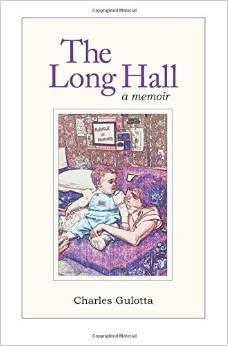
Two weeks earlier, I’d finished reading Charles’ memoir, the Long Hall.
The Long Hall by Charles Gulotta
It’s the story of how Charles and Jill met, fell in love, married, and had a daughter, Allison. It’s also the story of a simple twist of fate that changed their lives dramatically, when Jill suffered a stroke during childbirth. It’s the story of how Charles went from a happy expectant father, to a shocked but loving caregiver to two very different people, one infant and one adult, with very different needs.
It is now a month since I read the book. And honestly, I haven’t stopped thinking about it. The story sounds a wee bit depressing, doesn’t it? I will admit, there are a lot of rough patches. But that’s not what I found so memorable. What stayed with me is a constant feeling of hope.
Often, when I’ve read Charles’ delightful blog, Mostly Bright Ideas, I’ve felt that he’s gotten into my head, asked questions that have been milling around in my mind for years. With The Long Hall, Charles got into my heart as well. And I really think that this book will stay with me, always.
Read it. It is the most uplifting story I have read in decades.
Maybe you’ve seen this before. Maybe you haven’t. But it is worth watching. It is worth seeing again.
We do everything we can to protect our kids from possible dangers. Except when it comes to guns. Really. How can we as a country, we as thinking rational people, we as parents continue to let the NRA decide.
Get rid of politicians who won’t stand up to the NRA. Get rid of politicians who think that it is just dandy that anybody can get a gun. Or collect enough of them to maintain an arsenal.
Protect your family. Vote these folks out of Dodge.







 FiftyFourandAHalf