Just the other day, I got an early birthday gift from a bloggin’ buddy. Benze from Benzeknees directed me to what is billed as “A very ACCURATE HOROSCOPE” — just when I was trying to figure out what to say about my birthday. January 18. I actually hate my birthday. I’d much rather celebrate someone else’s. But celebrating this milestone is traditional. And I am nothing if not traditional.
So thanks, Benze, you made life much easier!
CAPRICORN – The Passionate Lover (December 22 to January 19)
Love to bust. Nice. Sassy. Intelligent. Sexy. Grouchy at times and annoying to some. Lazy and love to take it easy, but when they find a job or something they like to do they put their all into it. Proud, understanding and sweet. Irresistible. Loves being in long relationships. Great talker. Always gets what he or she wants. Cool. Loves to win against other signs in sports, especially Gemini’s. Likes to cook but would rather go out to eat at good restaurants. Extremely fun. Loves to joke. Smart.
24 years of bad luck if you do not share this post.
There’s a bit of truth in it, even though I will admit to having no clue as to what “Love to bust” means. Grouchy? Ummm, yeah. Intelligent and Sassy? OK, often. “Great talker” — well, I’ll never get a job as a mime. “Always gets what he or she wants”? I’m working on it. Unfortunately it doesn’t say how long it takes … (I need a dog….)
The description that is closest to the mark is that I’m lazy. It’s true. And it makes it so that I don’t have to do any more work on this post.
Yes, I’m going to post what I put up last year. And the year before. It’s true. I am going to post the song that sums up my life these days as a new 57-year old:
Today, April 22, is Earth Day! It’s the 43nd Anniversary of the very first Earth Day. Here for Angie of Childhood Relived (because I am her primary new source) is Walter Cronkite’s report on the first Earth Day, 1970:
It would also be my late sister Judy’s 61th birthday.
Whoever made the decision to turn Judy’s birthday into Earth Day chose wisely. Judy was a born environmentalist and recycler.
On the first Earth Day, Judy was a new, very young mother who believed in saving the planet. She was the first “environmentalist” I ever knew personally, and well, I thought she was nuts. There was a recycling bin in her kitchen for as long as I can remember. And this was back when recycling took effort. She believed in gardens, not garbage, and she made life bloom wherever she was.
“I’ve got kids,” she’d say. “It’s their planet too!”
But years later, Judy took recycling to a whole different level when she helped people recycle themselves. In the 1990s, Jude, who was then living in Florida, began working with the Homeless, assisting at shelters. Then she actively began trying to help homeless vets find food, shelter and work — to enable them to jumpstart their lives.
When she died in early 2000, the American Legion awarded her honorary membership for her services to homeless vets. A homeless shelter was named in her honor. So she’s still doing good works, my sister is. That would make her wildly happy.
Jude also gave me the Beatles. So it is very appropriate that they wrote a song for her.
You see, the night the Beatles were on Ed Sullivan, it was MY turn to choose what we were going to watch. And we were going to watch the second part of The Scarecrow of Romney Marsh starring Patrick McGoohan on the Wonderful Wide World of Disney. My four (all older and MUCH cooler) siblings were furious with me. But I was quite insistent. You might even say that I threw a Class I temper tantrum over it, but I wouldn’t admit to that. But hey, I was seven. And it was my turn to choose. Fair is fair, especially in a big family with only one TV.
Somehow, Judy talked me out of my turn. She was always very persuasive. Thanks Jude.
Hey Jude, Happy Earth Day-Birthday.
* * *
If this looks/sounds familiar, it’s because I recycled this post from last year. Because you should never use fresh when you can reuse something already written. And you can never get enough of “Hey Jude.”
Before 1986 there were two things in life I was certain about. Things I never got wrong on a pop quiz. Things that I could recite in my sleep.
First my name. Elyse Ellen E….
When I got married I didn’t have to change my name. That was until the woman I worked for at the time announced that I absolutely could not change my name. So naturally the decision was made and I changed it.
Besides, nobody ever pronounced my maiden name correctly; it drove me crazy. Nobody pronounces my married name right either, but it’s John’s name not mine, so I don’t care. Butcher away, folks.
The second thing I always got right was my birthday. January 18, 1957. Simple. Easy. I had a document from the State of Connecticut with a raised seal to prove that I was born on that date around 3 a.m. in the morning (sorry Mom and Dad). But I didn’t know that I would end up changing my birthday when I got married too.
Actually, I can blame this one on the same boss. It was Anna’s fault. Yup.
The summer before we got married, I was working as a high level lobbyist and John was a lowly government employee. OK, actually, I was a lowly lobbying flunky and John was pretty high up in the U.S. government. But still.
One afternoon when I was supposed to meet John for some wedding prep stuff, something earth-shatteringly important happened involving my job. It was so vitally important to the rest of the history of the world that I can’t at this moment quite put my finger on just exactly what it was.
Anyway, we were supposed to go to the DC City Office and get our marriage license. Now stop it, readers. This event was nothing like you see in those old movies, with movie stars in great hats.
Really, there was nothing romantic about it at all. I don’t think. Not so I’ve heard, anyway.
So anyway, John got our marriage license, and we got married a month or so later in a lovely church service in the church where John’s parents had been married 40 years earlier. Family and friends were in attendance.
All was good until my birthday rolled around, when John made a major confession.
“Ummm, Lease,” he said quietly. “When I got the marriage license, I mistakenly put down January 17th not 18th as your birthday.”
“You what?”
“Yeah. Oops. I guess that means that either your birthday is January 17th or we’re not married.”
“No, I’m pretty sure it just means that I married an idiot.”
We would have happily left it at that if it hadn’t been for my family. They betrayed me. Each and every one of them called me on the 17th to wish me a Happy Birthday that year — thinking my new husband would be taking me out to dinner on my actual birthday January 18th.
I have a large family. Even distant cousins nine times removed called on the 17th.
“See,” John said proudly, “I was right. Your birthday is obviously on the 17th because everybody is calling to wish you a happy birthday!”
This scene has been replayed every blippin’ year for 25 years. This year it will be an even 26 birthdays. And never a call on the 18th.
To make matters worse, though, I put the final nail in my own coffin myself last year. You see, I wanted to let all my bloggin’ buddies know it was my birthday. Plus I needed to address the glaring issue of my stupid blog name. And so I wrote this post: People My Age.
And because I didn’t know how to schedule posts in those days, and because a lot of my readers were from Europe and Asia, well, I posted it on January bloody 17th.
So this year I’ve given up. My birthday is January 17th from now on. Or the 18th. Whenever. Gifts will be gracefully received all month long, however.
He’s been a hero of mine for more than thirty years. A short little guy who I’m pretty sure was bald in high school. But over the years I’ve watched him fight. He’s fought tirelessly for a cleaner environment, a safer world, and for all kinds of tools, programs and systems to help improve the health of Americans.
I’m speaking of course of Representative Henry Waxman (D-CA), past and future Chairman, currently Ranking Minority Member (head Democrat) of the House Energy and Commerce Committee.
Representative Henry Waxman (D-CA) (Roll Call photo credit)
Energy and Commerce isn’t just any crummy old Committee. Nope. E&C has jurisdiction over a zillion things that touch our lives. Energy (fossil fuels, wind, solar, alternatives), environmental issues (Clean water, clean air, pollution controls on cars and trucks), interstate commerce, the internets (Al Gore was on E&C when he really was instrumental in the start of what became the World Wide Web. So he is actually the father of all blogs, too — thanks Al). E&C is a seriously powerful committee. And when I was a young professional, well, I was an Energy and Commerce Committee groupie. More about that some other time.
Early on, Henry became my hero. And not just because he is incredibly funny. He’s also incredibly smart and quite crafty. Isn’t it nice to know that sometimes heroes just keep on keepin’ on? Henry? Congressman Waxman? Yup. He’s like that. He’s still my hero. He doesn’t disappoint.
You see, today I read that he, along with Rep. Frank Pallone, Jr. (D-NJ), Ranking Member of the Health Subcommittee, released a treasure trove of information to help Americans sort stuff out for November’s election. But it’s simple, clear, and easy to use. That is especially helpful, don’t you think? You’ve got to admit that all of these Medicare/Social Security/Vaginal issues are getting confusing.
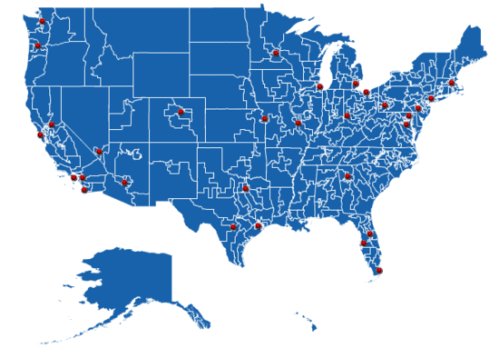
But now, now thanks to Henry, now we can sort out just what the Ryan plan will mean closer to home. Because they just released a compilation of what the Ryan Plan will mean in each and every congressional district in the United States. These were put together by an assortment of independent, government and academic thinkers who have analyzed the Paul Ryan Medicare Changes to see what it will mean to you and me. Yup, everybody can now see just exactly what GOP Candidate for Vice President Paul Ryan’s Medicare plan will mean to them and the people in their own little congressional districts. As in right here at home.
The Paul Ryan Medicare Plan; How will it affect your district?
So go ahead. Check it out. Click on it. It took me forever to figure out how to do that, too. Humor me. What would these changes mean in your district? In your life?
I’ve been working on this post for weeks. I never do that. I even went back and forth over whether I should tell it, and if so, whether the anniversary of D-Day was the right time to do so.
But this story kind of haunts me. I change my mind about it all the time. I try to work it out in my mind, but I can never be certain of what really happened. So now I’ll let you think about it, too.
In late June 1998, John, Jacob and I took my Dad, then aged 81, to Normandy, France to visit the D-Day landing beaches, museums, the works. Dad was a WWII vet – he was in the U.S. Navy during the War, stationed on two different aircraft carriers in the Pacific. He fought in some of the big battles in the Pacific, as a gunner on an SBD Dauntless, a seriously cool little plane.
But Dad was always fascinated by the D-Day landings. The planning, the strategy. The very real possibility that it could have failed. And he had lost friends there. Two of Dad’s closest childhood friends died there, they’d gone ashore at Omaha Beach. Dad had always wanted to visit Normandy. So when he came to visit us in Switzerland, we took a road trip.
The folks in Normandy, well, they love Americans. We stayed in Sainte-Mère-Église at a lovely farmhouse on the outskirts of town. The owner of the farm treated Dad like royalty, even though he told her he was fighting in the Pacific. The trip was, my Dad said forever afterwards, one of the highlights of his life.
Now, you know what happened on D-Day. The invasion began when the Allies sent paratroopers into some of the strategic areas slightly inland from the Normandy Beaches they would invade later on that day, on the morning of June 6th. There were many problems with the drops of these paratroopers. Some of the most dramatic stories came from survivors who dropped into Ste. Mère-Église.
You see, that night, June 5/6, there was a fire in the town hall. All the townspeople were out, along with the German occupiers, trying to put out the fire. It spread to several nearby buildings.
Into the midst of this chaos, the American paratroopers fell. Many of them were shot by German troops as they dropped, butchered. Others were caught on trees, on buildings –including John Steele. Steele had parachuted into the middle of town, and his parachute was caught on the church steeple. Steele played dead for many hours, with the church bell ringing in his ear, watching many of his fellow paratroopers die. Steele was memorably portrayed by Red Buttons in the movie The Longest Day.
There are still parachutes on many of the buildings commemorating the landings.
Things changed, the Allies won, the day/night. Ste. Mère-Églisewas the first town liberated by the Allies on June 6, 1944. D-Day. It was a vital victory for the Allies, for the French, and really, for the world.
John Steele survived and returned to Ste. Mère-Égliseafter the war.He opened up a restaurant that became a huge draw for tourists, including us. Our first night in town, we had reservations. But we were early, and the restaurant wasn’t yet open. So we went to a cafe/bar around the corner to get a drink while we waited for half an hour.
John, Dad, Jacob and I sat at a table, excitedly talking about our tour of the town. Ste. Mère-Église is seriously cool. There are still parachutes hanging in trees, on buildings. It is still a real town, but it is also a memorial to the men who fought and died there, and a place that welcomes veterans with affection and gratitude. Unlike much of France, the folks in Normandy truly remember. And they love Americans.
So sitting there at the table having a drink, we enthusiastically recounted what we’d seen so far. With two history buffs in the group, Jacob and I learned a lot from John and Dad. Placards explain the events of the night so that it is easily followed. We were all so excited, chatting about the history, explaining more to Jacob. We had seen so much already, and it was only our first night! The next day, we would visit the beaches. We were excited.
A man standing at the bar behind us was pretty excited too. Quite animated, in fact. But perhaps that was just because he had had three or four drinks too many.
“Damn, if I had it to do over again,” blared the drunk American at the bar. He followed it up with a string of obscenities that made my Dad, the sailor, blush. Then the drunk caught sight of me and 7-year-old Jacob. He wandered over to us and offered us his apologies. We politely accepted them. But he didn’t seem to take “no problem” as an answer. He introduced himself as Howard Something-or-other, and stood talking with us about how he had retired to Normandy.
Stupidly, I asked “What brought you to Normandy?”
“Well,” he said with a twinkle in his eye, “I happened to drop into town one night…”
“Oh, uhh, wow,” I said, looking skeptically between John and Dad. They didn’t seem to believe the guy either.
But Howard proceeded to tell his story:
“Yup,” he said, “I dropped in here one night. I landed in the cemetery over back by the Town Hall, which, as you know, was on fire.”
He continued: “First, I crapped my pants,” he announced, looking straight at my 7-year-old son who was mortified. I was pretty sure we didn’t need to hear that.
“Actually,” he said, “I really lucked out. The cemetery had a tall stone wall around it. And the Germans were occupied with the fire and then with the guys who were dropping into the middle of the town square. Me, I hid behind some gravestones until I realized that, hell, a cemetery is no place to die. So I made my way out, and linked up with my buddies.”
We didn’t believe a word of it. For one thing, the guy looked way too young. Remember, it was 1998, fifty-four years after the Normandy Invasion. Looking at him, I could see Howard couldn’t then have been more than 60 or 65. That put him in grammar school during the War. Besides, there was just something about him. None of us believed him.
Howard was meeting someone, and we had a dinner reservation. So we didn’t pursue his story.
But the next day when we went to buy postcards to send back home, well, we saw something rather surprising: A postcard of Howard Manoian.Our Howard from the night before. The drunk. The faker. The guy whose heroic WWII story we didn’t believe, and to which we only listened to a bit of, and then only out of politeness.
“Well,” said Dad sadly, “he was a bit of a weirdo.”
We felt really stupid at not having tackled the guy and listened to the rest of his story. Peppered him with questions. What a horrible lost opportunity. Imagine, to hear a first-hand account of what happened that night. June 6, 1944.
Howard in the Countryside (Google Image)
* * *
Fast forward to May/June 2009. The Sixty-fifth Anniversary of the Normandy Landings.
A few days before the 65th Anniversary of the D-Day landings, John sent me an interesting email. It was a link to a Boston Herald article that exposed “an American fraud.” Yup, you guessed it. Our Howard was revealed in the article to have not “dropped into” Ste. Mère-Église, after all. The article claimed that military records stated that Howard was part of the invasion force that landed at Utah Beach. (Which was seriously cool in and of itself.)
Even though I hadn’t believed him when he was standing next to me, I was really sad to read the story. Imagine living a lie for all that time. For sixty years. Howard had lived, part-time, in Ste. Mère-Église for decades. He had attended many D-Day ceremonies over those sixty-five years. He had been telling his story, albeit often under the influence, for many, many years.
And so I was sad. Yes, the guy had been “a bit of a weirdo” to quote Dad. And yes, he had been rather inebriated. But was he a fraud? Could “Weird Howard” have been living a lie for all those years? If so, how sad, how pitiful. But how could that happen, I wondered, to tell this lie in a place where veterans of D-Day flock? In a place where, I thought, sooner or later, someone would recognize him?
* * *
In traveling about, and especially visiting many battlefields with John, the history buff, I am often astonished at the images of what soldiers and sailors face in battle. But I have never been anywhere like Normandy.
When you stand on the beaches and look up at where the troops had to go, the price of what we often take for granted looms out of the ghosts. The cliffs are high, ragged. With no climbing skills at all, I can’t imagine trying to get to the top, much less with guns pointed and firing in my direction. And yet they did. And many of them died. Many of them were wounded. Many of them are still there, buried at the top of the cliffs, overlooking Omaha Beach. I felt an almost religious appreciation for the Greatest Generation‘s sacrifices. There is no physical place that to me represents the ancient struggle of good versus evil. It is awe-inspiring.
And really, it all started in and around Ste. Mère-Église.
* * *
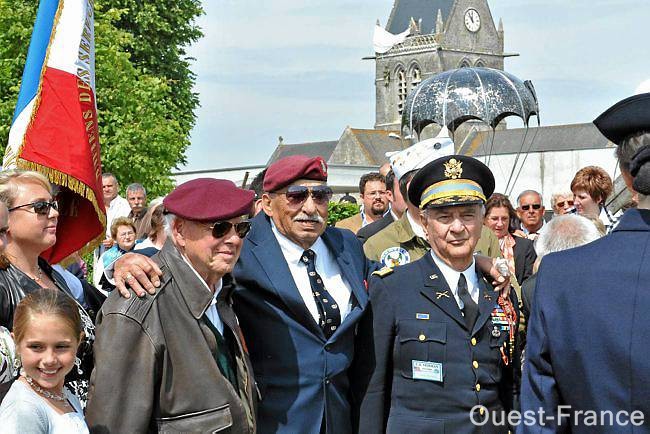
In researching this post, I found conflicting information about Howard. Some folks say Howard was a fraud. Others, including the French Government believe his story. And at the 65th Anniversary of D-Day, in 2009, the French Government awarded Howard their highest medal, the Legion of Honor for exemplary valor and service, even after the Boston Herald article “exposed him” as a fraud.
Howard in the center at the 65th Anniversary of the D-Day Landings (Google Image)
Me, I don’t know what to think.
Or maybe I do. I find it hard to believe that anyone could live such a lie for over 60 years and not be exposed much, much earlier. He told his story over and over, like Mr. Bojangles, for drinks and tips. Now you would think that if, in fact, he had gone ashore at Utah Beach, he would still qualify for hero status. Because, you know, the folks that fought there, regardless of in what capacity, division or from which country, well, they are all heroes. They all deserve our thanks.
More practically, the likelihood that he would have run into someone who recognized him from that day was pretty high. Folks remember. And folks return. I’m pretty sure at least some would have clear memories of who stood next to them on the landing craft or on a glider soaring silently above Ste. Mère-Église.
So in the intervening years, I have thought about Howard quite a bit. I wish we had heard more of his story. I wish, at a minimum, that we had bought him a beer, although he didn’t really need another one. I wish that Howard, who died just last year, didn’t pass with a cloud over his head.








 FiftyFourandAHalf